

The Two Worlds of Book Awards: Gatekept vs. Author-Submitted
Before comparing contests, it helps to understand how the two worlds differ.
World One: Industry-gatekept awards (no author entry fee)
These are a few of the most highly respected and prestigious children’s book awards in the United States — the Newbery Medal, the Caldecott Medal, and the Coretta Scott King Book Awards. They're administered by the American Library Association and decided by committees of librarians. There's no application fee because you don't apply; publishers submit titles, and committees review the year's output.
A few important things to know about this world:
- Self-published books are rarely in the running. While some ALA award criteria don't explicitly exclude indie titles, the practical reality is that committees review books submitted through publisher channels with review copies, trade reviews, and library distribution behind them.
- Publishers Weekly sits in this world too — its starred reviews and Best Books lists are editorially chosen, not entered. But PW created a bridge for indie authors: the BookLife Prize (more on that below), which is Publishers Weekly's paid contest specifically for self-published and unpublished work. It's the most direct route an indie author has to Publishers Weekly visibility.
- The Scholastic Art & Writing Awards deserve a mention because authors often ask me about "Scholastic awards." These prestigious awards include Stephen King. If you're a young writer or illustrator, or you're mentoring one, they're a wonderful opportunity. For the rest of us, they're not an entry point.
World Two: Author-submitted contests (entry fee required)
This is where self-published authors thrive, and it's a legitimate, valuable world — with a caveat. These contests charge entry fees (typically $60–$120 per category) because authors and small presses, not big publishers, fund them. The best of them — Foreword INDIES, the IBPA Book Award, Moonbeam, IPPY — have real judging panels of librarians, booksellers, editors, and designers, and their seals carry genuine weight with the gatekeepers you want to impress.
The caveat: the book award business is a business. Some contests exist mostly to sell seals and "winner packages." Before entering any contest, ask: Who judges? Is winning guaranteed, or do books have to earn a minimum score? Do winners get real promotion — press releases, library outreach, media lists — or just the right to buy stickers?
Why Awards Are Worth It: What a Seal Actually Does for Your Book
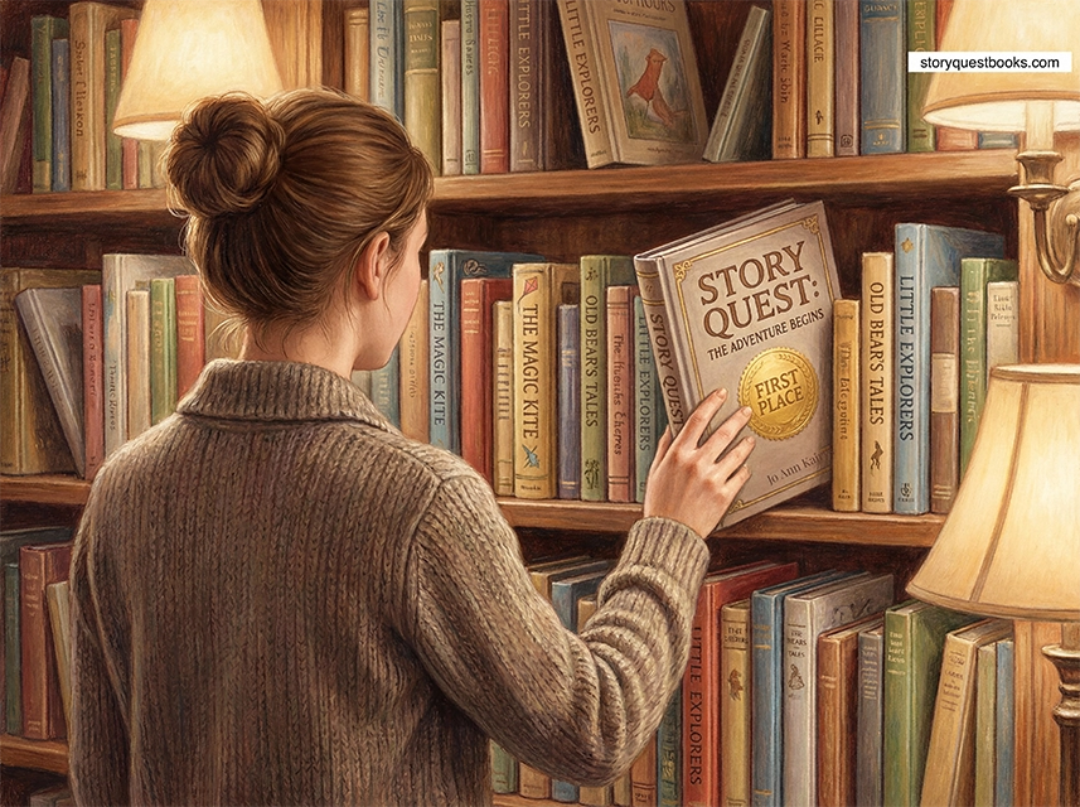
When authors ask me whether awards are worth the fees, I break it down this way:
1. Visibility and exposure. Award announcements go out to libraries, booksellers, and trade media. Foreword INDIES results, for example, are watched by librarians and booksellers specifically looking for indie titles they might have missed. Winners are often featured in award directories, ceremony programs, and press releases that live online indefinitely.
2. Author credibility. "Award-winning author" changes how gatekeepers read your pitch. It matters in query letters to bookstores, in applications for school visits and festivals, in your Amazon author bio, and in media outreach. For people building a long-term career, that phrase becomes part of their professional identity.
3. Social proof for buyers. Parents and grandparents standing in front of a shelf (or scrolling Amazon) make split-second quality judgments. A gold seal is a shortcut that says someone credible vetted this book. Seals like Mom's Choice are consciously designed as consumer-facing trust marks for exactly this moment.
4. Book sales. Awards don't sell books by themselves — but they amplify everything else you do. Award winners report stronger sales at events, easier bookstore consignment conversations, and better performance in promotions. One IPPY medalist put it well: the seal was the deciding factor in going to a second printing.
5. Doors you can't see yet. Foreign rights interest, agent attention, film/licensing inquiries, invitations to judge or speak — awards put your book in rooms you're not in. Several contests (BookLife Prize, IBPA) also return written judge feedback, which is professional editorial insight you can apply to your next book.
Story Quest Foreword INDIEFAB Award Example — A Real-Life Win
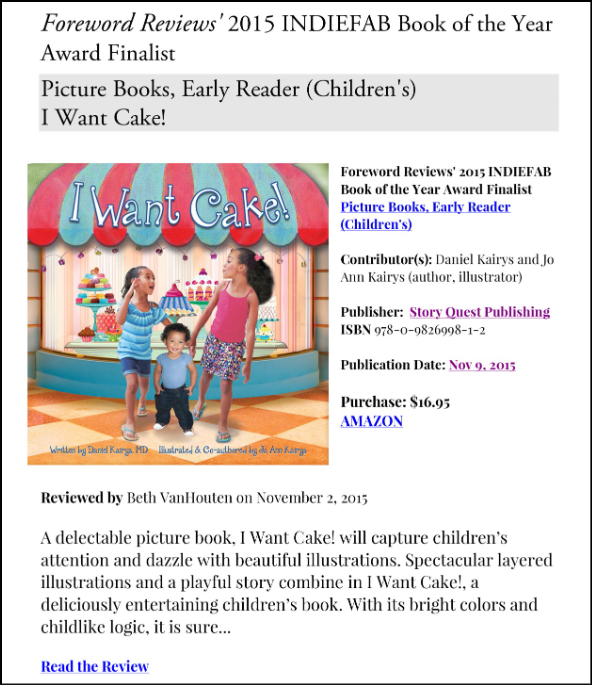
After my first book, SUNBELIEVABLE, earned multiple awards in 2012, including Mom’s Choice and Dragonfly, I felt confident entering my second book, I WANT CAKE! into the competitive Foreword Reviews INDIEFAB 2015 contest. Much to my surprise, it was one of five finalists for that year’s competition. The enthusiastic review, which focused on both storytelling and illustrations — “A Delectable Picture Book, I WANT CAKE!” immediately opened new opportunities.
Requests for press releases, media interviews, speaking engagements at national book conferences, school visits, book signings and readings rolled in. Ultimately, the strength of both books’ awards helped launch my freelance coaching and illustration business.
I had made every mistake in the self-publishing world on my own, doggedly persisted learning Photoshop and other digital image tools, and grew familiar with all the ins and outs of book production, printing, and marketing. I wanted to help others navigate this world with confidence.
I’m often asked to share the most important lessons learned in my publishing journey, my response is straightforward: do the best work you can, aim for quality in every aspect of your book, seek professional help when needed, and don’t give up!
AI-Generated Books: Read the Rules Before You Enter
This is the fastest-changing area in children’s book awards, and if you use AI anywhere in your process — text, illustration, or cover — you need to read each contest's rules before entering. The landscape right now:
- Outright bans. The Best Indie Book Award doesn't allow AI-generated books or illustrations at all — AI is permitted only for grammar checking. The Independent Author Network rules books "written entirely by AI" ineligible.
- The IPPY Awards state that AI use is discouraged and may factor into judges' final decisions.
- Policies in development. Story Monsters (Purple Dragonfly and Royal Dragonfly) is actively developing a formal policy to guide submissions that include AI-generated content of any kind.
- Strict enforcement is real. In late 2025, New Zealand's Ockham Book Awards disqualified two acclaimed, traditionally published novels because their covers contained AI-generated imagery — even though the writing was entirely human. The lesson: AI policies can extend to every element of your book, including work done by your cover designer.
If you're weighing how much AI belongs in your own process — not just whether a contest allows it — [I wrote about that trade-off here]. My advice to clients, and my own philosophy at Story Quest: AI earns its place in the work — it never takes over...
My advice to clients, and my own philosophy at Story Quest: AI earns its place in the work — it never takes over. If you've used AI tools anywhere in creating your book, keep records of your process, be prepared to disclose honestly, and when in doubt, email the contest coordinator before you pay the fee. Disqualification hurts far more than a skipped contest.
Choosing Awards Aligned with Your Book
Not every contest fits every book. Here's what I suggest for an effective award strategy:
- Match the contest to your book's age. Some contests require recent copyright dates (Moonbeam: 2024–2026; IPPY: 2024–2026; Foreword INDIES: current publication year only; IBPA: current copyright year). Others — Purple Dragonfly, Readers' Favorite, Mom's Choice — accept books of any publication age. If your book is a few years old, your options narrow, but they don't disappear.
- Match the contest to your goals. Want library and bookseller attention? Foreword INDIES and IBPA are judged by exactly those professionals. Want a consumer-facing seal for retail? Mom's Choice. Want professional feedback plus a shot at Publishers Weekly exposure? BookLife Prize. Want the strongest children-specific credentials? Moonbeam.
- Pick your category carefully. Most contests let you enter multiple categories (for additional fees). A picture book about a grandparent might fit "Picture Book," "Family Matters," and "Multicultural" categories — and a thoughtful category choice can mean competing against 30 books instead of 300. Read past winners in your category to gauge fit.
- Mind the calendar. Deadlines cluster: IPPY closes in late March, Purple Dragonfly in early May, Moonbeam in late August, Royal Dragonfly in early October, IBPA in mid-December, Foreword INDIES in mid-January. A book launching in spring can realistically hit four or five strong contests in its first year. Early-bird pricing (often $10–$20 off) rewards planning ahead.
- Budget realistically. A focused first-year award campaign — say, Moonbeam + Foreword INDIES + one more — runs roughly $250–$350 including shipping. That's a meaningful but reasonable line in a launch budget, and far better spent on three strong contests than scattered across eight questionable ones.
Don't Overlook Local and State-Based Awards: A NJ Example
Some of the best-kept secrets in book awards are close to home:
- State Center for the Book programs. Nearly every state has a Center for the Book (affiliated with the Library of Congress) that runs or promotes state book awards. Search "[your state] Center for the Book." Here in New Jersey, the NJ Center for the Book at the Rutgers School of Communication and Information champions state authors.
- State Library Association awards and children's choice lists. Many states run children's book award programs voted on by kids (New Jersey's Garden State Children's Book Awards, for example). Getting on these lists usually requires librarian nomination — which is a great reason to build relationships with your local children's librarians.
- Regional and community awards. Arts councils, writers' associations, and regional festivals frequently run book competitions with smaller entry pools — meaning better odds — and winners often get invitations to local events, which is where children's book sales actually happen.
Local wins also make wonderful local press stories. "Freehold author wins state book award" is exactly the headline your hometown paper is looking for.
How Awards Are Actually Decided
Understanding the judging process helps you submit smarter:
Who judges? Reputable contests use panels drawn from publishing: librarians, booksellers, editors, designers, teachers, and reviewers. Foreword INDIES is judged by editors, booksellers, and librarians; Moonbeam's panel includes experts from editing, design, reviewing, bookselling, and library fields; IBPA draws on over 170 publishing professionals.
What do they score? Children's book judging typically weighs content and storytelling, originality, design and illustration quality, and production values — how professionally the physical book is made. This is why editing, professional design, and print quality aren't optional extras; they're scoring criteria.
Minimum standards matter. In well-run contests, winning isn't automatic. Purple Dragonfly requires a minimum score of 60 out of 80 judge's points to win anything — even if a book is the only entry in its category. Contests without minimum standards (where every entrant "wins" something) offer seals that mean accordingly less.
Tiered results. Most contests award gold/silver/bronze medals or winner/finalist tiers per category, and some (BookLife Prize, IBPA) return written critiques to every entrant — genuinely useful feedback regardless of outcome.
Feedback loops. IBPA is notable for returning verbatim judging forms from all three judges to every entrant. Even if you don't medal, you walk away knowing exactly how publishing professionals assessed your book.
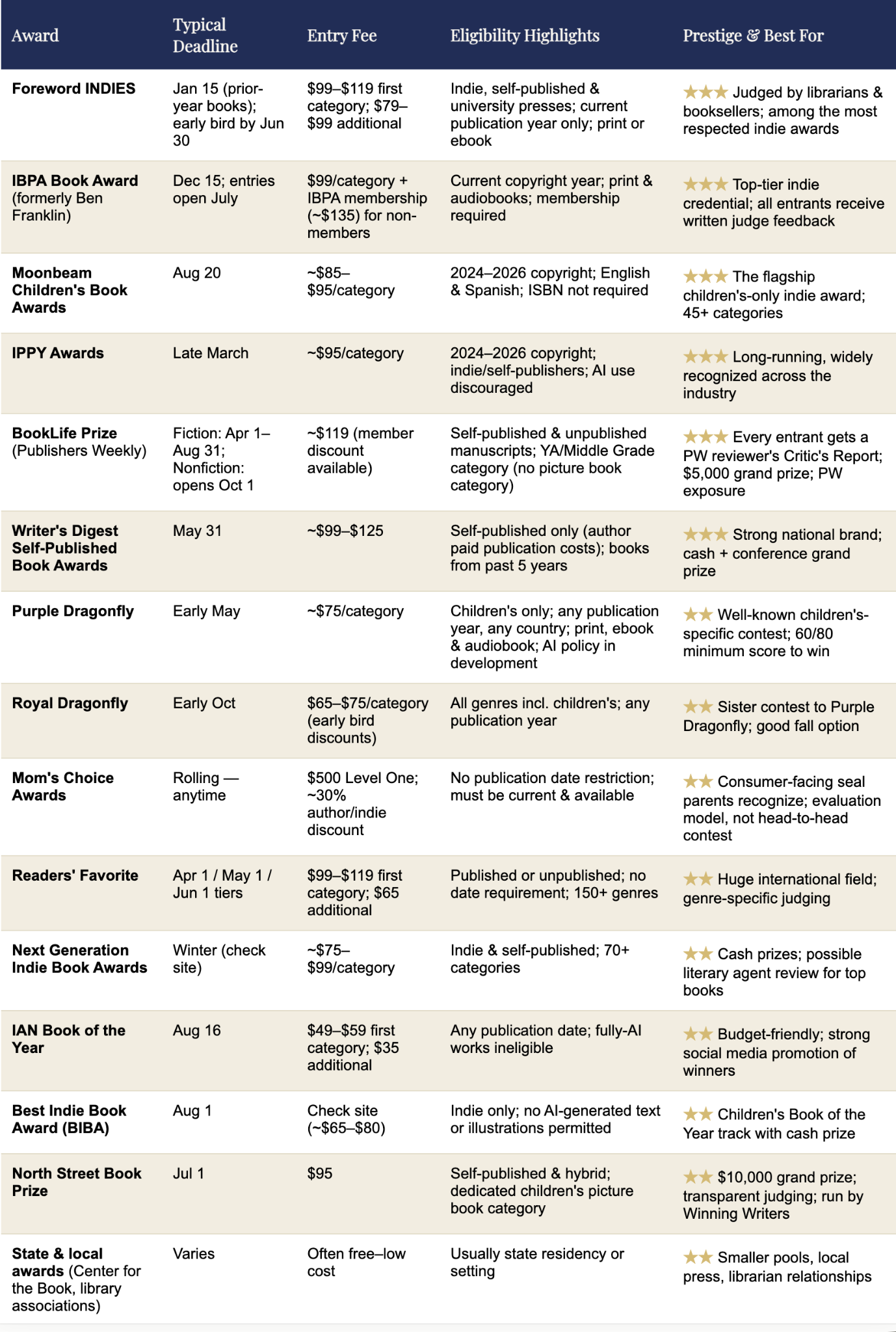
Use this comparison table to narrow your shortlist:
The Bottom Line
Awards won't replace a good book, a real marketing plan, or genuine connection with your readers. But chosen wisely, they're one of the highest-leverage investments a self-published children's author can make: a few hundred dollars for credibility assets that compound for the life of your book.
My rule of thumb: enter two or three contests where the judges are the people you most want to impress — librarians, booksellers, parents — and skip the rest. Read the AI policy. Pick your categories with intention. And when you win (notice I said when), put that seal to work everywhere: your cover, your website, your email signature, your next pitch.
Your story deserves to be found. An award seal is one more landmark pointing the way to it.
Wondering which award contests fit your book — or getting your illustrations award-ready? That's exactly the kind of planning we map out together. Book a free coaching call and I'd love to hear about your book.